
Self-Defense in Healthcare, Part 2: What is Self-Defense?
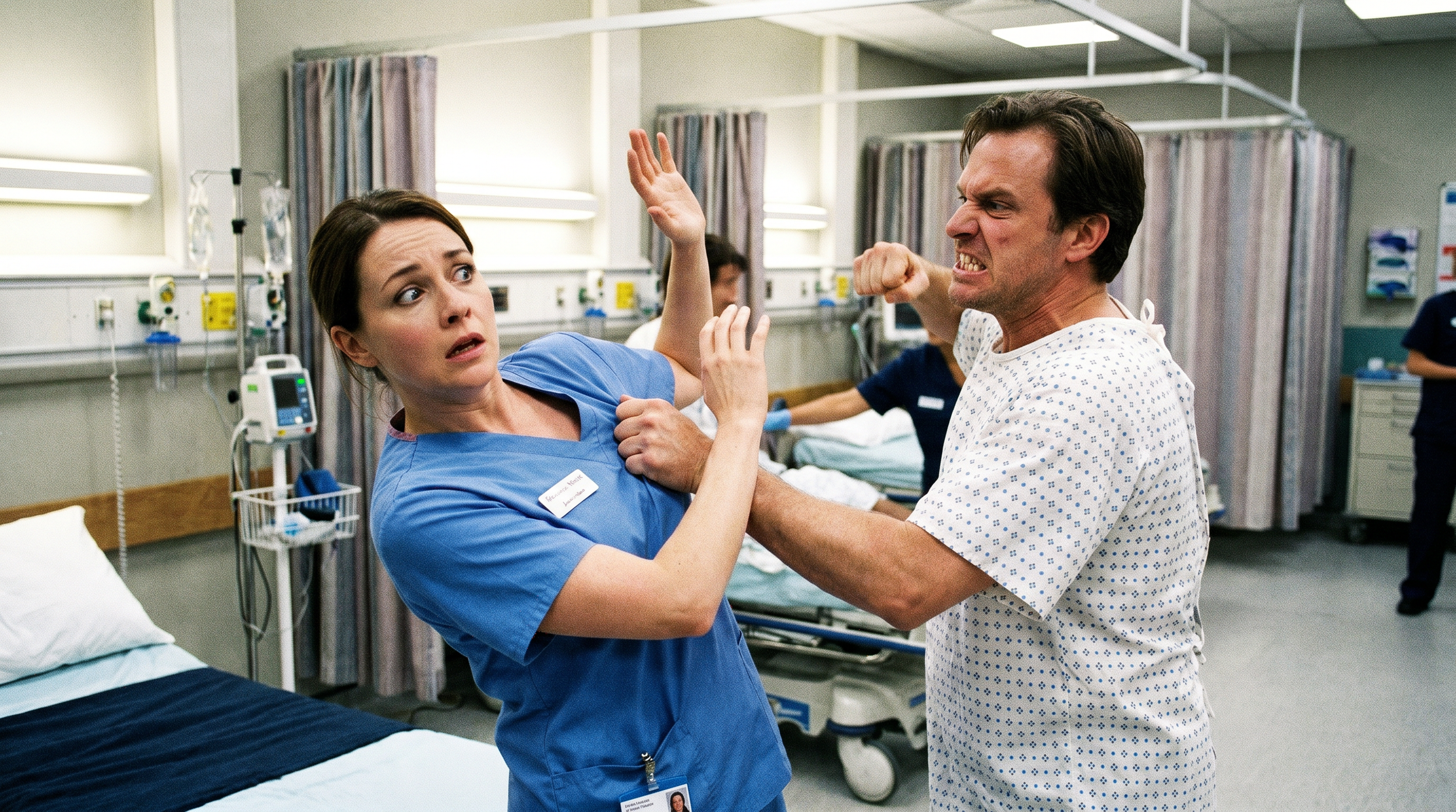
In an interesting update, the Colorado Supreme Court (just like the Utah Supreme Court) recently recognized that there is a right to self-defense in the workplace for which employers may not terminate workers as long as self-defense is lawfully used. The case was Moreno v. Circle K Stores, Inc. and the majority opinion was that the right to self-defense stemmed from pre-statehood days.
"It makes no sense to suggest that everyone has an inalienable right to defend themselves if faced with imminent danger, unless they are at work," wrote Berkenkotter [one of the justices]. "Rather, the right follows the employee from home to work and back and everywhere in between."
When talking on the topic of self-defense in healthcare, I know people are thinking, "But employees need to de-escalate." Yes, there's some truth to that. But let's be real - there are limitations to de-escalation. That's a whole other topic.
Let's talk about what self-defense is.
In plain language, self-defense is fighting back when someone is trying to hurt, maim, or kill you. The goal is to reduce or stop the attacks so that you can get away alive. You can use self-defense for someone else.
But a good rule of thumb is to get out of the situation before it escalates to violence, if you can.
In Oregon...
To get more technical, here's Oregon's definition: "Except as provided in ORS 161.215 (Limitations on use of physical force in defense of a person) and 161.219 (Limitations on use of deadly physical force in defense of a person), a person is justified in using physical force upon another person for self-defense or to defend a third person from what the person reasonably believes to be the use or imminent use of unlawful physical force, and the person may use a degree of force which the person reasonably believes to be necessary for the purpose."
Here's when you CAN use self-defense against someone when they are:
Attempting to commit a felony involving the use or threatened imminent use of physical force
Committing or attempting to commit burglary in a dwelling
Using or about to use unlawful deadly physical force against a person
Those limitations are:
You can't initiate violence and claim self-defense (normally), EXCEPT if you withdraw or disengage and the other person then comes after you with unlawful physical force
The violence is "combat by agreement"
The violence is due to discovery of a persons actual or perceived gender, gender identity, gender expression, or sexual orientation
In Oregon, it has been required to teach self-defense in healthcare settings since 2008, which needs to include:
The amount of physical force that is reasonably necessary to protect the employee or a third person from assault; and
The use of least restrictive procedures necessary under the circumstances, in accordance with an approved behavior management plan, and any other methods of response approved by the health care employer;
And the employer cannot sanction an employee for using self-defense if the employee was:
Acting in self-defense in response to the use or imminent use of physical force;
Used an amount of physical force that was reasonably necessary to protect the employee or a third person from assault; and
Used the least restrictive procedures necessary under the circumstances, in accordance with an approved behavior management plan, or other methods of response approved by the health care employer.
What is "reasonable force"?
It's complicated. Here are some highlights of what is taken into consideration in order for self-defense to be justified. A more in-depth article is linked below:
The threat must be imminent
The force must fit the threat
Reasonableness - the objective and subjective test - what you believed and what a reasonable person with the same knowledge and in the same situation would believe)
You can't be the aggressor - but you can regain the right to self-defense, as described above... at least in Oregon)
If you want to deep-dive into the intricacies of Reasonable Force
Self-Defense Training
Is self-defense taught in your violence prevention training? How often do staff train on the physical techniques? Does your program even teach the physical escape maneuvers or self-defense?
Training on physical skills once or twice per year is not going to develop muscle memory and the chances of successfully using a technique will be pretty low. In my opinion, we can't train our staff enough.
There's many differing martial arts, training styles, and defense philosophies for getting out of physical situations - some you know won't work in a truly violent situation. Getting personal, I've had 16 years of martial arts training, achieved a 4th degree black belt, and I know that I won't be able to successfully defend myself in some situations; especially if the aggressor is taller, heavier, more trained, has better leverage, catches me off guard, etc.
Some will say that you can only use the "approved" self-defense techniques that were taught in the hospital-provided violence prevention class. I'd challenge that. True self-defense should be "anything goes." If your goal is to come out alive with minimal injury, clawing skin, gouging eyes, biting, head-butting, grabbing genitals... anything is fair game. Your goal is to stop the attack, escape, and come out alive. And truly, if you only trained on those physical skills during the class, and the class was only offered once, you haven't trained on those "approved" skills enough
Summary
The aftermath of using self-defense in the healthcare space is, and will be, messy. There's going to be a lot of questions that need answers. There's going to be a lot of gray area to navigate. It's going to take time.
Next Steps
Hypothetically, the event happened. What are the next steps?
In the ideal world, the employer would ensure the safety of all parties involved and perform an in-depth investigation that is fair. The organization needs to assess the performance of the employee, and also it's own accountability. And since healthcare employers are not experts in use of force or self-defense, they may need to reach out to experts in those fields.
The next two editions will provide helpful topics and questions to consider when investigating the employee(s) involved and the organization itself.
Other readings on nurses and self defense:
Can Nurses Defend Themselves? (Michael Davis)